
How to use ABAOptions.com, and how to fit ABA into a bigger plan for your child.
When a child is diagnosed with autism, families often leave the evaluation with one clear recommendation and very little else: “Look into ABA.”
I’ve heard that story hundreds of times. Nearly all parents ask the same practical question: where do we even find a provider?
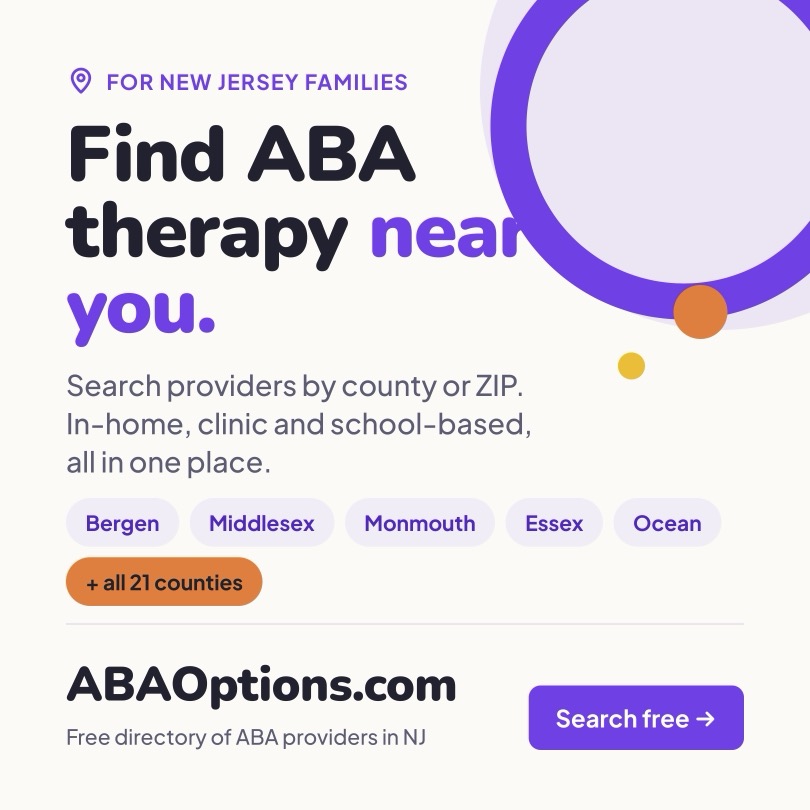
That question is why I created ABAOptions.com, a free, independent directory of about 250 ABA providers across New Jersey. But in my consulting work, I’ve learned that finding a provider is only the first step. The families who do best are the ones who see ABA as one piece of a larger plan, not the whole plan.
Step one: see your options clearly
ABAOptions.com lets you search by county, zip code, or key word to see which providers actually serve your area. It’s free, there’s no sign-up, and nobody will call you afterward. My team and I review the listings ourselves and keep in touch with providers to keep the information current.
Use it to build a short list, perhaps three to five providers, before you start making calls.
Step two: ask better questions
ABA programs vary enormously in quality and philosophy. Before you commit, ask each provider:
- Who supervises my child’s program? Ask about the BCBA’s experience and how often they’ll see your child in person.
- What does a session look like? Look for play, choice, and your child’s interests, not just drills.
- How are goals set, and how am I involved? Strong programs build goals with families and teach parents strategies to use at home.
- How do you respond when a child is distressed or says no? You want a clear, respectful answer.
- Do you take my insurance, and is there a waitlist? Confirm with both the provider and your insurer.
- How is progress measured and shared with us?
I’ll also be honest: ABA is widely covered and many families find it helpful, but it’s also debated, including by autistic adults who have criticized older, more rigid approaches. Asking these questions helps you find a program that fits your child and your values.
Step three: think beyond ABA
This is where many families get stuck, and where I spend much of my time with clients. ABA rarely happens in isolation. Your child may also be working with speech and occupational therapists, an early intervention team, a preschool or school district, and pediatric specialists.
Some of the questions that come up:
- How many therapy hours make sense for my child, and how do they fit around school and family life?
- What should the school be providing through an IEP, and what falls to private services?
- How do we coordinate goals across providers so everyone is pulling in the same direction?
- What should we be planning now for the years ahead, through elementary school, adolescence and the transition to adulthood?
There’s no one-size-fits-all answer to any of these, and the right answer changes as your child grows.
Where I come in
I’ve worked with autistic children and their families for most of my career, as a special education teacher in the South Bronx, a college professor, an education writer, the person who built the family programs at the Cope Center, and an autism mom. I’ve also completed advocacy training through the Council of Parent Attorneys and Advocates (COPAA).
At McKenna Autism Consulting, I work with families to make sense of the whole picture: services, school, and long-term planning. I’ll help you weigh options, prepare for meetings, and build a plan that fits your child, not just the next available opening.
Get started
- Looking for ABA providers in New Jersey? Start your search at ABAOptions.com.
- Want help thinking through what comes next? Book a free 30-minute intake call with me.
You don’t have to figure this out alone, and you don’t have to figure it all out at once.
— Laura McKenna, McKenna Autism Consulting